-

CoRE Lab at ISLS ’26
We’ll be presenting tools and findings from a number of our projects at the 2026 Annual Meeting of the International Society for the Learning Sciences! Come check out: Rivulet: A Framework and Tools for Fetching Custom, Pedagogically Generative Scientific Datasets introduces a framework and tools to help curriculum designers and teachers source relevant, pedagogically generative…
-

Choosy in Teaching Statistics
Educators are encouraged to teach with “big” datasets, but these are often unwieldy. We illustrate six strategies for making datasets manageable and maintaining alignment with statistical learning goals.
-
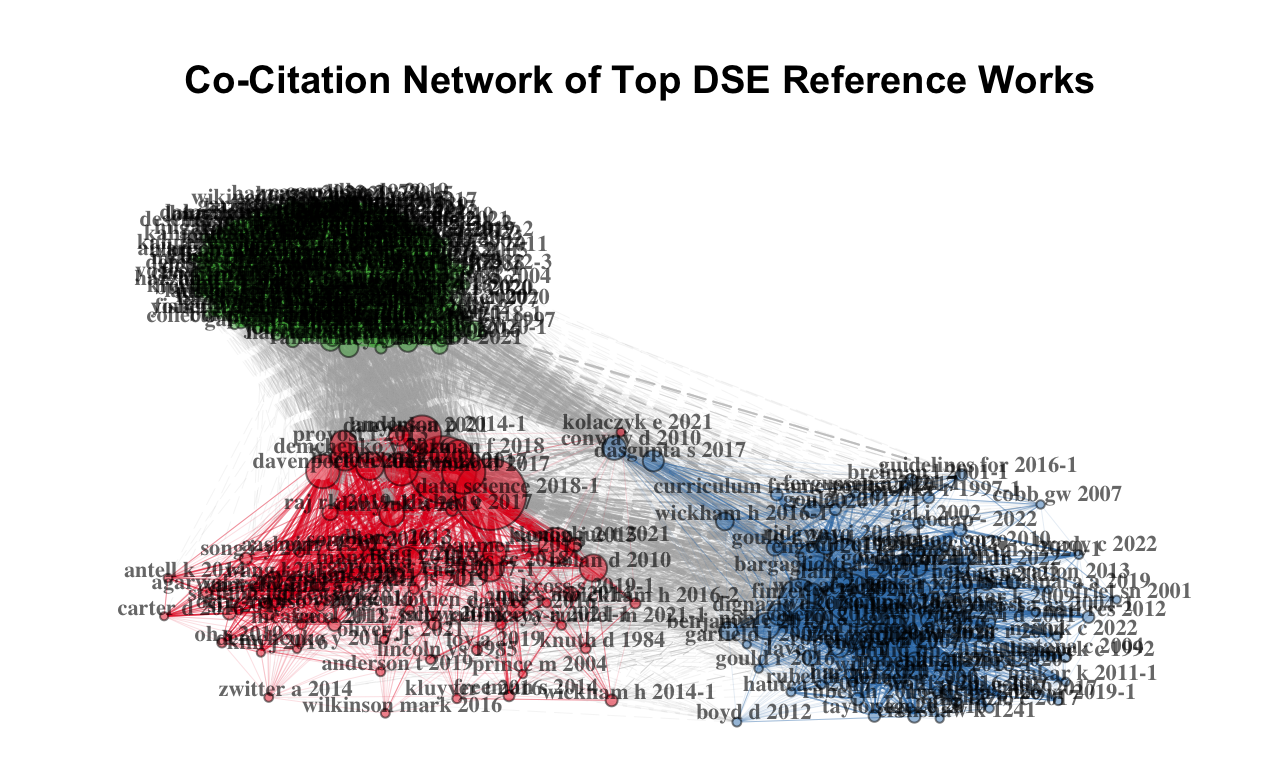
Mapping DSEd Lit in HDSR
A science mapping analysis that identifies three clusters in data science education literature: undergraduate, K-12, and computational approaches for nonmajors.
-
CoRE Lab Presentations at ISLS ’25
Come check out our work at the 2025 Annual Meeting of the International Society for the Learning Sciences!
-
CoRE @ Euro Congress of Math Ed (CERME-14)
Michelle was invited to present a plenary discussion at the 14th Congress of the European Society for Research in Mathematics Education (CERME14), hosted by the Free University of Bozen-Bolzano with colleague Rolf Biehler of Paderborn University. Curricular innovation was a theme throughout the conference, and Rolf and Michelle’s talk explored visions of Data Science Education…
-
Teachers & DataViz Discussions in IJSME
Leading classroom dataviz discussions can be tricky. This paper examines how a dataviz discussion guide can help teachers stay flexible, while meeting specific mathematical and scientific learning goals.
-
Aligning Ideas + Models in Cognition & Instruction
Computational tools hold promise for science education, but each tool models information in a different way. This paper explores ways to connect what students know to the language and structures of different modeling tools.
-

Sci Educ: When Models are “Right but Wrong”
Agent-based modeling can encourage students to think about scientific mechanisms. But to refine students’ understandings toward accurate explanations, comparing their models with data is just as important.
-

Fitzmaurice Recognized at ISLS ’24!
Helen’s full paper, “Activism or bureaucracy: What are we teaching students through local climate action projects?” won a Best Paper Award at the 2024 Meeting of the International Society for the Learning Sciences. Her paper examines the ways that teachers’ framing and enactment of student action projects shift over time toward different “orientations-of-action,” or ways…
-
Exploring Local Impacts and Global Change w/ Data
A new paper describes one of the units developed as part of the Writing Data Stories project, focused on connecting the local and global effects of climate change through storytelling and data.